
+91 7259945454 / +91 8792302559

|

info@univate.in

#10, Green County
Near Pope John Paul Church
Hormavu Post, Bangalore – 560043

Why Businesses Trust Univate for PCI DSS Compliance

12+ Years Consulting Experience:

Expertise in compliance, cybersecurity, data protection, and audit readiness.

PCI DSS Compliance Support:

End-to-end guidance for organizations handling cardholder data.

Gap Assessment to Audit Readiness:

Support from initial review to remediation and final compliance preparation.

India & Global Client Support:

Compliance consulting support for Indian businesses serving domestic and international customers.

Banvien Vietnam Central Bank UAE CME Lebanon Datasoft Bangladesh In2IT Technologies InfoTrack Innentine Lean leao MEWA NIC Saudi Arabia RTA Dubai Solutions by STC Saudi Arabia STC Tahaluf-al-emarat UAE TCSENS Virtualguru Wakeb data Saudi

PCI DSS Certification Consulting in India

PCI DSS Assessment & Gap Analysis:

Identify gaps in your current payment card data environment and security controls.

Cardholder Data Security Support:

Protect stored, processed, and transmitted cardholder data with PCI DSS-aligned controls.

ASV Scanning & Vulnerability Support:

Get support for approved scanning vendor requirements, vulnerability checks, and remediation.

Audit Readiness & Compliance Guidance:

Prepare documentation, evidence, technical controls, and teams for PCI DSS assessment.

What is PCI DSS Certification?

PCI DSS (Payment Card Industry Data Security Standard) is a globally recognized framework designed to protect cardholder data and ensure secure payment transactions. It applies to all businesses that store, process, or transmit credit or debit card information.

This certification ensures your organization follows strict security practices to prevent data breaches, fraud, and unauthorized access.

The 12 Core Requirements of PCI DSS

  • Install and Maintain Network Security Controls:
    Protect cardholder data environments using firewalls, network controls, and secure configurations.
  • Apply Secure Configurations: Avoid default passwords and insecure system settings across servers, applications, devices, and infrastructure.
  • Protect Stored Account Data: Secure stored cardholder data using encryption, masking, retention controls, and secure storage practices.
  • Protect Cardholder Data During Transmission: Encrypt cardholder data when transmitted across open, public, or untrusted networks.
  • Protect Systems from Malware: Use anti-malware tools, monitoring, and security controls to protect systems from malicious software.
  • Develop and Maintain Secure Systems and Software: Apply secure coding, patch management, vulnerability management, and secure development practices.
  • Restrict Access to Cardholder Data: Limit access to cardholder data based on business need-to-know.
  • Identify Users and Authenticate Access: Use unique user IDs, strong authentication, and access control mechanisms.
  • Restrict Physical Access to Cardholder Data: Protect physical access to systems, devices, records, and environments containing cardholder data.
  • Log and Monitor Access: Track, monitor, and review access to networks, systems, and cardholder data.
  • Test Security Systems and Processes: Perform vulnerability scans, penetration testing, and regular security testing.
  • Maintain Information Security Policy: Create and maintain security policies, procedures, awareness programs, and compliance responsibilities.

Who Needs PCI DSS Certification?

PCI DSS is mandatory for any organization involved in payment card processing, including:

  • E-commerce companies
  • Payment gateways & processors
  • Banks & financial institutions
  • SaaS & fintech companies
  • Retailers handling card payments

Any business handling cardholder data must comply with PCI DSS standards.

Understanding PCI DSS Compliance Levels

  • PCI DSS Level 1:
    For merchants processing the highest volume of card transactions annually. Level 1 usually requires a detailed assessment and Report on Compliance.
  • PCI DSS Level 2:
    For businesses processing a significant number of card transactions but below Level 1 thresholds.
  • PCI DSS Level 3:
    For businesses processing a moderate number of e-commerce card transactions annually.
  • PCI DSS Level 4:
    For smaller merchants processing lower transaction volumes.

Compliance level depends on transaction volume, payment channel, card brand rules, and payment processor requirements.

Our Process

PCI DSS Implementation Process in India

Our structured approach ensures smooth certification

Scoping & Gap Analysis:

Identify the cardholder data environment, systems, applications, networks, processes, and third parties involved in payment card processing.

Remediation

Fix identified gaps related to policies, access controls, network security, vulnerability management, encryption, logging, and technical controls.

ASV Scanning

Conduct external vulnerability scanning through an Approved Scanning Vendor where applicable.

Assessment

Review documentation, evidence, security controls, system configurations, access logs, policies, and PCI DSS implementation status.

Attestation

Prepare required compliance documentation such as SAQ, ROC, AOC, or other applicable reports based on business type and compliance level.

Certification must be validated annually for continued compliance.

Get A Free Quote

Benefits of PCI DSS Certification

Achieving PCI DSS compliance provides:

  • Reduced risk of data breaches
  • Increased customer trust
  • Better partnership with banks & payment providers
  • Strong cybersecurity posture
  • Competitive advantage in global markets

Key Industries Requiring PCI DSS

  • Retail & E-Commerce:
    Retail stores and online businesses require PCI DSS to secure payment transactions, checkout systems, POS systems, and customer card data.
  • IT, BPO & KPO:
    IT service providers, BPOs, and KPOs may require PCI DSS if they process, store, transmit, or support systems handling payment card data.
  • FinTech & Banking:
    FinTech companies, payment gateways, banks, and financial service providers need PCI DSS to protect payment data and transaction systems.
  • Hospitality & Travel:
    Hotels, travel agencies, booking platforms, and tourism companies require PCI DSS when they accept card payments for reservations and services.

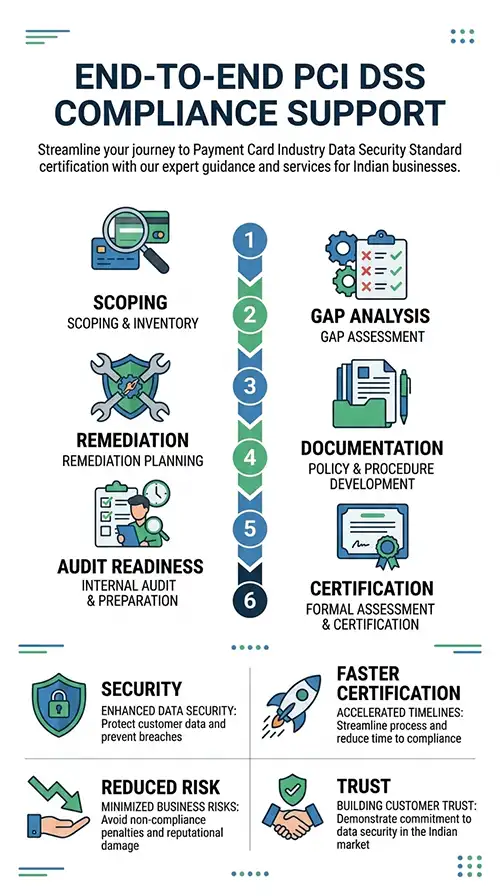
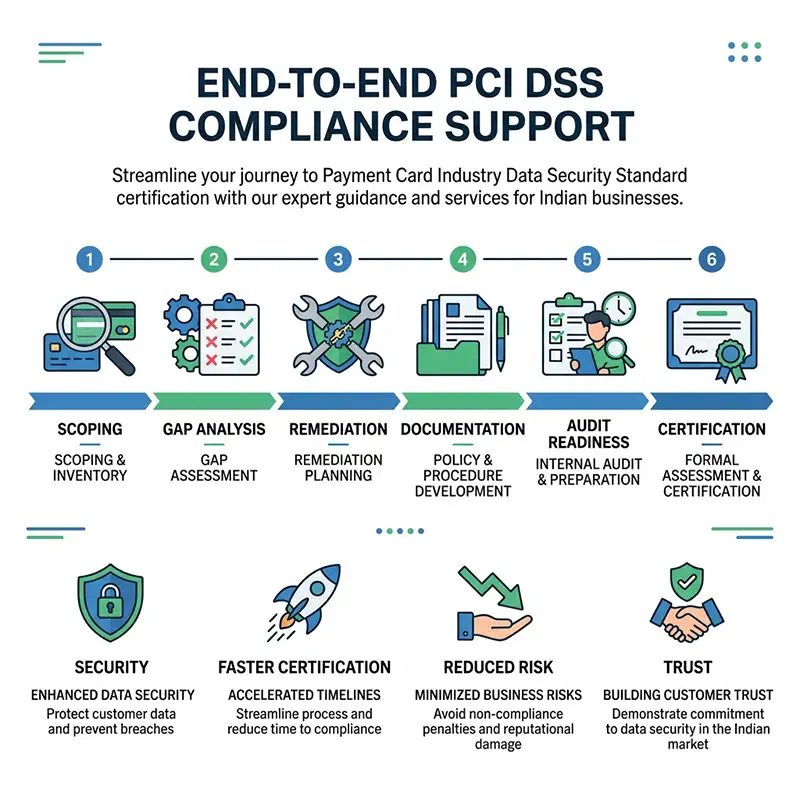
End-to-End PCI DSS Compliance Support in India

End-to-End Compliance Support ensures a smooth and efficient journey toward PCI DSS Certification in India by covering every stage of the compliance lifecycle. From initial scoping and gap analysis to remediation, documentation, audit readiness, and final validation, this approach provides continuous expert guidance aligned with the standards of the PCI Security Standards Council. It helps organizations streamline processes, avoid costly errors, and achieve faster certification while maintaining long-term compliance and security of cardholder data.

Timeframe for PCI DSS Compliance

The timeframe for PCI DSS compliance depends on your organization size, payment environment, current security maturity, number of systems in scope, documentation readiness, and remediation requirements.

Estimated timeline:

  • Small businesses: 4 to 8 weeks
  • Medium organizations: 2 to 4 months
  • Large or complex environments: 4 to 6 months or more

Organizations with strong security controls and documentation may complete the process faster. Businesses with multiple systems, applications, locations, and payment flows may need more time for remediation and evidence preparation.

PCI DSS Compliance Cost in India

PCI DSS compliance cost in India depends on your business size, compliance level, transaction volume, cardholder data environment, technology setup, and remediation needs.

Cost factors include:

  • PCI DSS compliance level
  • Merchant or service provider category
  • Number of systems in scope
  • Number of locations
  • Payment channels used
  • Existing security controls
  • Documentation readiness
  • Vulnerability scanning requirements
  • Penetration testing requirements
  • Remediation effort
  • QSA or audit support requirements
  • SAQ, ROC, or AOC requirements

For an accurate cost estimate, it is best to conduct a PCI DSS gap assessment and define the scope of your cardholder data environment.


Why Choose Us for PCI DSS Certification in India

Experienced PCI DSS
Consultants

End-to-end compliance
support

Industry-specific
solutions

Faster certification
approach

Affordable
pricing

321
+

Engagement Completed

300

Customer Served

215
+

Certificate Issued

100
%

Satisfied Customers

Get PCI DSS Compliance Services

Experience best in class services by Univate's PCI DSS Consultants from GAP Analysis to final assessment and till getting certified

About us

Who We Are

Univate Solutions Private Limited is a trusted provider of PCI DSS Certification in India, helping businesses secure payment systems and achieve fast, hassle-free compliance.

With 12+ years of experience and successful implementations across global clients, we deliver end-to-end PCI DSS services—from gap analysis and remediation to audit readiness and certification support—aligned with the PCI Security Standards Council.

Partner with Univate to simplify compliance, reduce risks, and get PCI DSS certified quickly.

Why PCI DSS Certification is Important in India

With the rapid growth of digital payments, e-commerce, and fintech in India, securing customer payment data has become critical. PCI DSS certification:

  • Protects sensitive cardholder information
  • Builds trust with customers and payment partners
  • Reduces risk of cyberattacks and fraud
  • Helps meet global payment security requirements
  • Improves brand credibility and compliance posture

Key PCI DSS Requirements

PCI DSS includes 12 core security requirements designed to protect cardholder data:

  • Build and maintain secure networks
  • Protect stored cardholder data
  • Encrypt data transmission
  • Implement strong access control
  • Regularly monitor and test systems
  • Maintain information security policies

These controls ensure complete protection of payment environments.

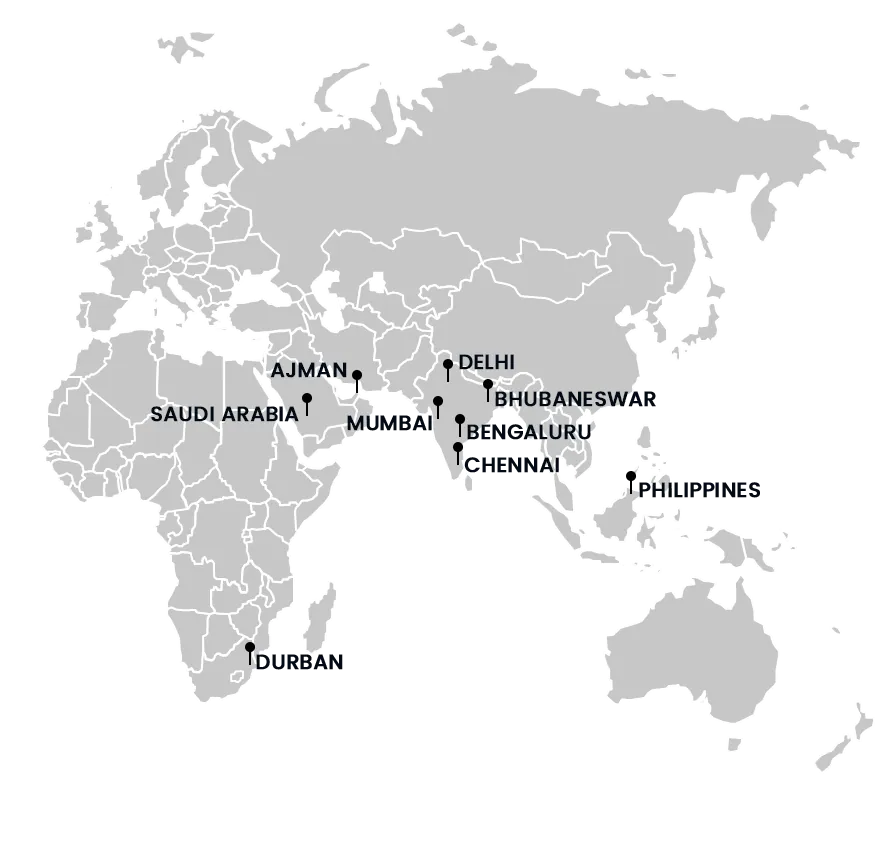
PCI DSS Compliance Support Across India

  • Bangalore: PCI DSS consulting support for FinTech, SaaS, IT, e-commerce, and payment processing companies in Bangalore.
  • Mumbai: PCI DSS compliance support for banks, financial services, retail, payment gateways, and enterprise businesses in Mumbai.
  • Delhi NCR: PCI DSS consulting for e-commerce businesses, IT service providers, BPOs, and payment-related companies in Delhi NCR.
  • Hyderabad: PCI DSS implementation and audit readiness support for technology, SaaS, and payment processing companies in Hyderabad.
  • Pune: PCI DSS consulting support for IT, FinTech, SaaS, and service companies in Pune.
  • Chennai: PCI DSS compliance support for retail, IT, BPO, payment processing, and enterprise businesses in Chennai.
  • Ahmedabad: PCI DSS consulting for growing e-commerce, IT, retail, and payment service businesses in Ahmedabad.
  • Kolkata: PCI DSS support for retail, hospitality, IT, financial, and service-based companies in Kolkata.

Ready to Start Your PCI DSS Compliance Journey?

Secure cardholder data, reduce payment security risks, and prepare your business for PCI DSS compliance with expert consulting support from Univate. Our team can guide you from scoping and gap analysis to remediation, ASV scanning, documentation, and audit readiness.

Client Testimonials

Call Now | Get PCI DSS Quote

Frequently Asked Questions


Is PCI DSS mandatory in India?
+
Yes, for businesses handling card payments, PCI DSS compliance is required by payment networks and banks.
It is valid for one year and requires annual renewal.
Non-compliance can lead to fines, penalties, and increased risk of data breaches.
PCI DSS includes 12 key requirements covering network security, data protection, access control, monitoring, and security policies to ensure complete protection of cardholder data.
Compliance means following PCI DSS standards, while certification is the formal validation done by a Qualified Security Assessor (QSA).
SAQ (Self-Assessment Questionnaire) is a validation tool for merchants to assess their PCI DSS compliance without a full audit, depending on their transaction type.
Yes, even small businesses must comply if they accept card payments. PCI DSS applies to all organizations regardless of size.
A professional PCI DSS consultant helps you reduce compliance time, avoid costly mistakes, and ensures faster certification with proper documentation and audit support.
A QSA (Qualified Security Assessor) is a certified professional authorized by the PCI Security Standards Council to assess and validate PCI DSS compliance for organizations.
Yes, many parts of PCI DSS compliance—such as documentation review, gap analysis, and consultation—can be done remotely, but some cases may require on-site assessment depending on your infrastructure and scope.